In the rapidly evolving landscape of global manufacturing, custom sheet metal fabrication remains the backbone of innovation. From intricate aerospace components to robust industrial enclosures, the ability to transform raw metal into precise, functional parts is what separates market leaders from the rest.
However, for procurement managers and design engineers, finding a fabrication partner isn’t just about bending metal—it’s about finding a strategic ally who understands precision, scalability, and cost-efficiency.
1. What is Custom Sheet Metal Fabrication?
Custom sheet metal fabrication is a comprehensive manufacturing process that involves cutting, bending, and assembling metal sheets (typically 0.006 to 0.25 inches thick) into specific shapes based on unique engineering designs.
Unlike off-the-shelf solutions, “custom” means every cut is calculated, and every weld is purposeful. Whether you are working with stainless steel, aluminum, copper, or galvanized steel, the process requires a blend of high-tech machinery and artisanal expertise.
2. Core Processes: Turning Blueprints into Reality
To achieve the “Precision” in precision sheet metal fabrication, top-tier manufacturers utilize several key technologies:
A. Fiber Laser Cutting
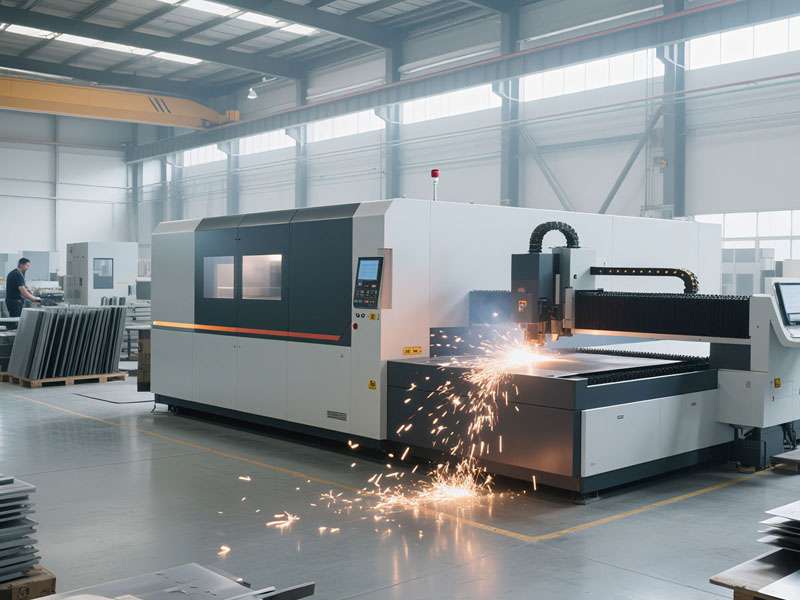
Laser cutting is the gold standard for accuracy. Modern fiber lasers can achieve tolerances as tight as ±0.05mm, ensuring that complex geometries are executed perfectly without heat-affected zone (HAZ) distortions.
B. CNC Bending and Forming
Using Computer Numerical Control (CNC) press brakes, fabricators can achieve complex angles and multi-bend sequences with extreme repeatability. This is crucial for high-volume production runs where consistency is non-negotiable.
C. Welding and Assembly
From TIG (Tungsten Inert Gas) for clean, aesthetic welds on stainless steel to MIG (Metal Inert Gas) for structural strength, the assembly phase is where the product takes its final form. Advanced shops also offer robotic welding to reduce lead times and labor costs.
D. Surface Finishing
A custom part isn’t finished until it’s protected. Options like powder coating, anodizing, plating, and laser engraving not only improve aesthetics but also provide essential corrosion resistance.
3. Selecting the Right Material for Your Project
Material selection directly impacts both the performance and the cost of custom sheet metal fabrication.
| Material | Key Benefits | Common Applications |
| Stainless Steel (304/316) | Corrosion resistance, high strength. | Medical, Food Service, Marine. |
| Aluminum (6061/5052) | Lightweight, excellent conductivity. | Aerospace, Electronics, Automotive. |
| Cold Rolled Steel | Cost-effective, smooth finish. | Appliances, Enclosures, Brackets. |
| Copper & Brass | Thermal/Electrical conductivity. | Busbars, Heat Sinks, Decorative. |
4. Why OEMs Prefer Custom Fabrication Over Standard Solutions
Many enterprises face the dilemma: “Should we adapt our design to standard parts or go custom?” Here is why custom sheet metal fabrication usually wins:
- Optimization for Function: Custom parts are designed for the product, not the other way around. This reduces the need for additional adapters and weakens points.
- Weight Reduction: Through clever design and precise material thinning, custom fabrication can significantly reduce the total weight of an assembly, which is critical for the EV and aerospace sectors.
- Brand Identity: Custom enclosures allow for unique branding, integrated logos, and specific color-matching that off-the-shelf boxes cannot provide.
5. Cost Drivers in Sheet Metal Fabrication (And How to Optimize Them)
Every engineer wants to lower the “price per part.” Understanding these drivers can help you optimize your RFQ (Request for Quote):
- Design Complexity: Every additional bend and hole increases machine time. Adhering to DFM (Design for Manufacturing) principles—such as maintaining uniform bend radii—can slash costs.
- Batch Size: While we offer sheet metal prototyping, the economy of scale is real. Increasing a run from 100 to 1,000 units can often reduce the unit price by 30-50%.
- Tooling: Utilizing standard hole sizes reduces the need for custom punch tools.
- Tolerance Requirements: Do not over-engineer. Requesting ±0.01mm when ±0.1mm is sufficient will unnecessarily drive up the inspection and scrap costs.
6. How to Choose a Global Custom Sheet Metal Partner
When searching for a partner in the global market, look beyond the price tag. Evaluate them based on:
I. Quality Certifications
Ensure the facility is ISO 9001:2015 certified. For specialized industries, look for AS9100 (Aerospace) or ISO 13485 (Medical).
II. Prototyping Speed
In today’s market, speed to market is everything. A partner that offers rapid sheet metal prototyping allows you to test and iterate designs in days, not weeks.
III. Supply Chain Integration
A truly valuable partner handles more than just the metal. Can they manage the hardware insertion? Can they handle the final packaging and global logistics? Vertical integration reduces your overhead and simplifies your vendor list.
7. The Future: AI and Automation in Fabrication
The industry is shifting toward Industry 4.0. Leading custom sheet metal fabricators are now using AI to optimize nesting (reducing material waste) and automated loading systems that allow for “lights-out” manufacturing. This technology ensures that custom fabrication remains competitive against traditional mass-production methods like die casting or plastic injection molding.
8. Conclusion: Your Vision, Our Precision
Custom sheet metal fabrication is the bridge between a visionary design and a tangible product. By choosing a partner that prioritizes precision, understands material science, and offers scalable production, you ensure your project’s success from the very first prototype.
Are you ready to bring your design to life?
Whether you have a fully-vetted CAD file or just a preliminary sketch, our team of expert engineers is ready to help you optimize for cost and quality.
[Contact Us Today for a Free DFM Review & Quote]


